Total Pageviews

Showing posts with label Dow. Show all posts

Wednesday, March 23, 2016

The Complete History Of Monsanto, “The World’s Most Evil Corporation” (Re-Post from Zen Gardner)

Before I post the topic at hand, General Mills will soon be labeling their packaging to indicate the presence of GMOs in their products - special thanks to the state of Vermont.


The Complete History Of Monsanto, “The World’s Most Evil Corporation”

Of all the mega-corps running amok, Monsanto has consistently outperformed its rivals, earning the crown as “most evil corporation on Earth!” Not content to simply rest upon its throne of destruction, it remains focused on newer, more scientifically innovative ways to harm the planet and its people.
As true champions of evil, they won’t stop until…well, until they’re stopped! But what is Monsanto and how did they get to be so obscenely evil in the first place? I think that’s the best place to start this journey, so grab a few non-GMO snacks or beverages and let’s go for a ride into the deep, murky sewers of their dark past.
1901: The company is founded by John Francis Queeny, a member of the Knights of Malta, a thirty year pharmaceutical veteran married to Olga Mendez Monsanto, for whichtoxiclove-300x272 Monsanto Chemical Works is named. The company’s first product is chemical saccharin, sold to Coca-Cola as an artificial sweetener.
Even then, the government knew saccharin was poisonous and sued to stop its manufacture but lost in court, thus opening the Monsanto Pandora’s Box to begin poisoning the world through the soft drink.
1920s: Monsanto expands into industrial chemicals and drugs, becoming the world’s largest maker of aspirin, acetylsalicyclic acid, (toxic of course). This is also the time when things began to go horribly wrong for the planet in a hurry with the introduction of their polychlorinated biphenyls (PCBs).
PCBs were considered an industrial wonder chemical, an oil that wouldn’t burn, impervious to degradation and had almost limitless applications. Today PCBs are considered one of the gravest chemical threats on the planet. Widely used as lubricants, hydraulic fluids, cutting oils, waterproof coatings and liquid sealants, are potent carcinogens and have been implicated in reproductive, developmental and immune system disorders. The world’s center of PCB manufacturing was Monsanto’s plant on the outskirts of East St. Louis, Illinois, which has the highest rate of fetal death and immature births in the state.(1)
Even though PCBs were eventually banned after fifty years for causing such devastation, it is still present in just about all animal and human blood and tissue cells across the globe. Documents introduced in court later showed Monsanto was fully aware of the deadly effects, but criminally hid them from the public to keep the PCB gravy-train going full speed!
1930s: Created its first hybrid seed corn and expands into detergents, soaps, industrial cleaning products, synthetic rubbers and plastics. Oh yes, all toxic of course!
1940s: They begin research on uranium to be used for the Manhattan Project’s first atomic bomb, which would later be dropped on Hiroshima and Nagasaki, killing hundreds of thousands of Japanese, Korean and US Military servicemen and poisoning millions more.
The company continues its unabated killing spree by creating pesticides for agriculture containing deadly dioxin, which poisons the food and water supplies. It was later discovered Monsanto failed to disclose that dioxin was used in a wide range of their products because doing so would force them to acknowledge that it had created an environmental Hell on Earth.
1950s: Closely aligned with The Walt Disney Company, Monsanto creates several attractions at Disney’s Tomorrowland, espousing the glories of chemicals and plastics. Their “House of the Future” is constructed entirely of toxic plastic that is not biodegradable as they had asserted. What, Monsanto lied? I’m shocked!
After attracting a total of 20 million visitors from 1957 to 1967, Disney finally tore the house down, but discovered it would not go down without a fight. According to Monsanto Magazine, wrecking balls literally bounced off the glass-fiber, reinforced polyester material. Torches, jackhammers, chain saws and shovels did not work. Finally, choker cables were used to squeeze off parts of the house bit by bit to be trucked away.(2)

Monsanto’s Disneyfied vision of the future:

1960s: Monsanto, along with chemical partner-in-crime DOW Chemical, produces dioxin-laced Agent Orange for use in the U.S.’s Vietnam invasion. The results? Over 3 million people contaminated, a half-million Vietnamese civilians dead, a half-million Vietnamese babies born with birth defects and thousands of U.S. military veterans suffering or dying from its effects to this day!
Monsanto is hauled into court again and internal memos show they knew the deadly effects of dioxin in Agent Orange when they sold it to the government. Outrageously though, Monsanto is allowed to present their own “research” that concluded dioxin was safe and posed no negative health concerns whatsoever. Satisfied, the bought and paid for courts side with Monsanto and throws the case out. Afterwards, it comes to light that Monsanto lied about the findings and their real research concluded that dioxin kills very effectively.
A later internal memo released in a 2002 trial admitted:
that the evidence proving the persistence of these compounds and their universal presence as residues in the environment is beyond question … the public and legal pressures to eliminate them to prevent global contamination are inevitable. The subject is snowballing. Where do we go from here? The alternatives: go out of business; sell the hell out of them as long as we can and do nothing else; try to stay in business; have alternative products.(3)
Monsanto partners with I.G. Farben, makers of Bayer aspirin and the Third Reich’s go-to chemical manufacturer producing deadly Zyklon-B gas during World War II. Together, the companies use their collective expertise to introduce aspartame, another extremely deadly neurotoxin, into the food supply. When questions surface regarding the toxicity of saccharin, Monsanto exploits this opportunity to introduce yet another of its deadly poisons onto an unsuspecting public.
1970s: Monsanto partner, G.D. Searle, produces numerous internal studies which claim aspartame to be safe, while the FDA’s own scientific research clearly reveals that aspartame causes tumors and massive holes in the brains of rats, before killing them. The FDA initiates a grand jury investigation into G.D. Searle for “knowingly misrepresenting findings and concealing material facts and making false statements” in regard to aspartame safety.
During this time, Searle strategically taps prominent Washington insider Donald Rumsfeld, who served as Secretary of Defense during the Gerald Ford and George W. Bush presidencies, to become CEO. The corporation’s primary goal is to have Rumsfeld utilize his political influence and vast experience in the killing business to grease the FDA to play ball with them.
A few months later, Samuel Skinner receives “an offer he can’t refuse,” withdraws from
the investigation and resigns his post at the U.S. Attorney’s Office to go work for Searle’s law firm. This mob tactic stalls the case just long enough for the statute of limitation to run out and the grand jury investigation is abruptly and conveniently dropped.
1980s: Amid indisputable research that reveals the toxic effects of aspartame and as then FDA commissioner Dr. Jere Goyan was about to sign a petition into law keeping it off the market, Donald Rumsfeld calls Ronald Reagan for a favor the day after he takes office. Reagan fires the uncooperative Goyan and appoints Dr. Arthur Hayes Hull to head the FDA, who then quickly tips the scales in Searle’s favor and NutraSweet is approved for human consumption in dried products.This becomes sadly ironic since Reagan, a known jelly bean and candy enthusiast, later suffers from Alzheimers during his second term, one of the many horrific effects of aspartame consumption.
Searle’s real goal though was to have aspartame approved as a soft drink sweetener since exhaustive studies revealed that at temperatures exceeding 85 degrees Fahrenheit, it “breaks down into known toxins Diketopiperazines (DKP), methyl (wood) alcohol, and formaldehyde.”, becoming many times deadlier than its powdered form!
The National Soft Drink Association (NSDA) is initially in an uproar, fearing future lawsuits from consumers permanently injured or killed by drinking the poison. When Searle is able to show that liquid aspartame, though incredibly deadly, is much more addictive than crack cocaine, the NSDA is convinced that skyrocketing profits from the sale of soft drinks laced with aspartame would easily offset any future liability. With that, corporate greed wins and the unsuspecting soft drink consumers pay for it with damaged healths.
Coke leads the way once again (remember saccharin?) and begins poisoning Diet Coke drinkers with aspartame in 1983. As expected, sales skyrocket as millions become hopelessly addicted and sickened by the sweet poison served in a can. The rest of the soft drink industry likes what it sees and quickly follows suit, conveniently forgetting all about their initial reservations that aspartame is a deadly chemical. There’s money to be made, lots of it and that’s all that really matters to them anyway!
In 1985, undaunted by the swirl of corruption and multiple accusations of fraudulent research undertaken by Searle, Monsanto purchases the company and forms a new aspartame subsidiary called NutraSweet Company. When multitudes of independent scientists and researchers continue to warn about aspartame’s toxic effects, Monsanto goes on the offensive, bribing the National Cancer Institute and providing their own fraudulent papers to get the NCI to claim that formaldehyde does not cause cancer so that aspartame can stay on the market.
The known effects of aspartame ingestion are: “mania, rage, violence, blindness, joint-pain, fatigue, weight-gain, chest-pain, coma, insomnia, numbness, depression, tinnitus, weakness, spasms, irritability, nausea, deafness, memory-loss, rashes, dizziness, headaches, seizures, anxiety, palpitations, fainting, cramps, diarrhoea, panic, burning in the mouth. Diseases triggered/mimmicked include diabetes, MS, lupus, epilepsy, Parkinson’s, tumours, miscarriage, infertility, fibromyalgia, infant death, Alzheimer’s… Source : U.S. Food & Drug Administration.
Further, 80% of complaints made to the FDA regarding food additives are about aspartame, which is now in over 5,000 products including diet and non-diet sodas and sports drinks, mints, chewing gum, frozen desserts, cookies, cakes, vitamins, pharmaceuticals, milk drinks, instant teas, coffees, yogurt, baby food and many, many more! Read labels closely and do not buy anything that contains this horrific killer!
Amidst all the death and disease, FDA’s Arthur Hull resigns under a cloud of corruption and is immediately hired by Searle’s public relations firm as a senior scientific consultant. No, that’s not a joke! Monsanto, the FDA and many government health regulatory agencies have become one and the same! It seems the only prerequisite for becoming an FDA commissioner is that they spend time at either Monsanto or one of the pharmaceutical cartel’s organized crime corps.
1990s: Monsanto spends millions defeating state and federal legislation that disallows the corporation from continuing to dump dioxins, pesticides and other cancer-causing poisons into drinking water systems. Regardless, they are sued countless times for causing disease in their plant workers, the people in surrounding areas and birth defects in babies.
With their coffins full from the massive billions of profits, the $100 million dollar settlements are considered the low cost of doing business and thanks to the FDA, Congress and White House, business remains very good. So good that Monsanto is sued for giving radioactive iron to 829 pregnant women for a study to see what would happen to them.
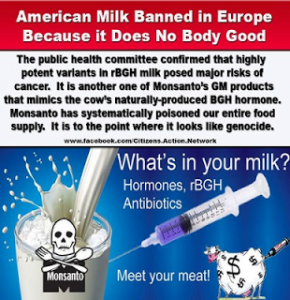
In 1994, the FDA once again criminally approves Monsanto’s latest monstrosity, the Synthetic Bovine Growth Hormone (rBGH), produced from a genetically modified E. coli bacteria, despite obvious outrage from the scientific community of its dangers. Of course, Monsanto claims that diseased pus milk, full of antibiotics and hormones is not only safe, but actually good for you!
Worse yet, dairy companies who refuse to use this toxic cow pus and label their products as “rBGH-free” are sued by Monsanto, claiming it gives them an unfair advantage over competitors that did. In essence, what Monsanto was saying is “yeah, we know rBGH makes people sick, but it’s not alright that you advertise it’s not in your products.”
The following year, the diabolical company begins producing GMO crops that are tolerant to their toxic herbicide Roundup. Roundup-ready canola oil (rapeseed), soybeans, corn and BT cotton begin hitting the market, advertised as being safer, healthier alternatives to their organic non-GMO rivals. Apparently, the propaganda worked as today over 80% of canola on the market is their GMO variety.
A few things you definitely want to avoid in your diet are GMO soy, corn, wheat and canola oil, despite the fact that many “natural” health experts claim the latter to be a healthy oil. It’s not, but you’ll find it polluting many products on grocery store shelves.
Because these GM crops have been engineered to ‘self-pollinate,’ they do not need nature American-Milk-Banned-in-Europe-290x300or bees to do that for them. There is a very dark side agenda to this and that is to wipe out the world’s bee population.
Monsanto knows that birds and especially bees, throw a wrench into their monopoly due to their ability to pollinate plants, thus naturally creating foods outside of the company’s “full domination control agenda.” When bees attempt to pollinate a GM plant or flower, it gets poisoned and dies. In fact, the bee colony collapse was recognized and has been going on since GM crops were first introduced.
To counter the accusations that they deliberately caused this ongoing genocide of bees, Monsanto devilishly buys out Beeologics, the largest bee research firm that was dedicated to studying the colony collapse phenomenon and whose extensive research named the monster as the primary culprit! After that, it’s “bees, what bees? Everything’s just dandy!” Again, I did not make this up, but wish I had!
During the mid-90s, they decide to reinvent their evil company as one focused on controlling the world’s food supply through artificial, biotechnology means to preserve the Roundup cash-cow from losing market-share in the face of competing, less-toxic herbicides. You see, Roundup is so toxic that it wipes out non-GMO crops, insects, animals, human health and the environment at the same time. How very efficient!
Because Roundup-ready crops are engineered to be toxic pesticides masquerading as food, they have been banned in the EU, but not in America! Is there any connection between that and the fact that Americans, despite the high cost and availability of healthcare, are collectively the sickest people in the world? Of course not!
As was Monsanto’s plan from the beginning, all non-Monsanto crops would be destroyed, forcing farmers the world over to use only its toxic terminator seeds. And Monsanto made sure farmers who refused to come into the fold were driven out of business or sued when windblown terminator seeds poisoned organic farms. [Editor’s Note: terminator seeds are not on the commercial market – instead, farmers must sign binding agreements that they will not save seeds.]
This gave the company a virtual monopoly as terminator seed crops and Roundup worked hand in glove with each other as GMO crops could not survive in a non-chemical environment so farmers were forced to buy both.
Their next step was to spend billions globally buying up as many seed companies as possible and transitioning them into terminator seed companies in an effort to wipe out any rivals and eliminate organic foods off the face of the earth. In Monsanto’s view, all foods must be under their full control and genetically modified or they are not safe to eat!
They pretend to be shocked that their critics in the scientific community question whether crops genetically modified with the genes of diseased pigs, cows, spiders, monkeys, fish, vaccines and viruses are healthy to eat. The answer to that question is obviously a very big “no way!”
It’s quite okay though to force-feed poor nations and Americans these modified monstrosities as a means to end starvation since dead people don’t need to eat! I’ll bet the thought on most peoples’ minds these days is that Monsanto is clearly focused on eugenics and genocide, as opposed to providing foods that will sustain the world. As in Monsanto partner Disney’s Sleeping Beauty, the wicked witch gives the people the poisoned GMO apple that puts them to sleep forever!
2000s: By this time Monsanto controls the largest share of the global GMO market. In turn, the US gov’t spends hundreds of millions to fund aerial spraying of Roundup, causing massive environmental devastation. Fish and animals by the thousands die within days of spraying as respiratory ailments and cancer deaths in humans spike tremendously. But this is all considered an unusual coincidence so the spraying continues. If you thought Monsanto and the FDA were one and the same, well you can add the gov’t to that sorry list now.
The monster grows bigger: Monsanto merges with Pharmacia & Upjohn, then separates from its chemical business and rebrands itself as an agricultural company. Yes, that’s right, a chemical company whose products have devastated the environment, killed millions of people and wildlife over the years now wants us to believe they produce safe and nutritious foods that won’t kill people any longer. That’s an extremely hard-sell, which is why they continue to grow bigger through mergers and secret partnerships.
Because rival DuPont is too large a corporation to be allowed to merge with, they instead form a stealth partnership where each agrees to drop existing patent lawsuits against one another and begin sharing GMO technologies for mutual benefit. In layman’s terms, together they would be far too powerful and politically connected for anything to stop them from owning a virtual monopoly on agriculture; “control the food supply & you control the people!”
Not all is rosy as the monster is repeatedly sued for $100s of millions for causing illness, infant deformities and death by illegally dumping all manner of PCBs into ground water, and continually lying about products safety – you know, business as usual.
The monster often perseveres and proves difficult to slay as it begins filing frivolous suits against farmers it claims infringe on their terminator seed patents. In virtually all cases, unwanted seeds are windblown onto farmers’ lands by neighboring terminator-seeded farms. Not only do these horrendous seeds destroy the organic farmers’ crops, the lawsuits drive them into bankruptcy, while the Supreme Court overturns lower court rulings and sides with Monsanto each time.
At the same time, the monster begins filing patents on breeding techniques for pigs, claiming animals bred any way remotely similar to their patent would grant them ownership. So loose was this patent filing that it became obvious they wanted to claim all pigs bred throughout the world would infringe upon their patent.
The global terrorism spreads to India as over 100,000 farmers who are bankrupted by GMO crop failure, commit suicide by drinking Roundup so their families will be eligible for death insurance payments. In response, the monster takes advantage of the situation by alerting the media to a new project to assist small Indian farmers by donating the very things that caused crop failures in the country in the first place! Forbes then names Monsanto “company of the year.” Sickening, but true.
More troubling is that Whole Foods, the corporation that brands itself as organic, natural and eco-friendly is proven to be anything but. They refuse to support Proposition 37, California’s GMO-labeling measure that Monsanto and its GMO-brethren eventually helped to defeat.
However, when over twenty biotech-friendly companies including WalMart, Pepsico and ConAgra recently met with FDA in favor of mandatory labelling laws, this after fighting tooth and nail to defeat Prop 37, Whole Foods sees an opportunity to save face and becomes the first grocery chain to announce mandatory labelling of their GMO products…in 2018!
And if you think its peers have suddenly grown a conscience, think again. They are simply reacting to the public’s outcry over the defeat of Prop 37 by crafting deceptive GMO-labelling laws to circumvent any real change, thus keeping the status quo intact.
To add insult to world injury, Monsanto and their partners in crime Archer Daniels Midland, Sodexo and Tyson Foods write and sponsor The Food Safety Modernization Act of 2009: HR 875. This criminal “act” gives the corporate factory farms a virtual monopoly to police and control all foods grown anywhere, including one’s own backyard, and provides harsh penalties and jail sentences for those who do not use chemicals and fertilizers. President Obama decided this sounded reasonable and gave his approval.
With this Act, Monsanto claims that only GM foods are safe and organic or homegrown foods potentially spread disease, therefore must be regulated out of existence for the safety of the world. If eating GM pesticide balls is their idea of safe food, I would like to think the rest of the world is smart enough to pass.
As further revelations have broken open regarding this evil giant’s true intentions, Monsanto crafted the ridiculous HR 933 Continuing Resolution, aka Monsanto Protection Act, which Obama robo-signed into law as well.This law states that no matter how harmful Monsanto’s GMO crops are and no matter how much devastation they wreak upon the country, U.S. federal courts cannot stop them from continuing to plant them anywhere they choose. Yes, Obama signed a provision that makes Monsanto above any laws and makes them more powerful than the government itself. We have to wonder who’s really in charge of the country because it’s certainly not him!
There comes a tipping point though when a corporation becomes too evil and the world pushes back…hard! Many countries continue to convict Monsanto of crimes against humanity and have banned them altogether, telling them to “get out and stay out!”
The world has begun to awaken to the fact that the corporate monster does not want control over the global production of food simply for profit’s sake. No, it’s become clear by over a century of death & destruction that the primary goal is to destroy human health and the environment, turning the world into a Mon-Satanic Hell on Earth!
Research into the name itself reveals it to be latin, meaning “my saint,” which may explain why critics often refer to it as “Mon-Satan.” Even more conspiratorially interesting is that free masons and other esoteric societies assigned numbers to each letter in our latin-based alphabet system in a six system. Under that number system, what might Monsanto add up to? Why, of course 6-6-6!
Know that all is not lost. Evil always loses in the end once it is widely exposed to the light of truth as is occurring now. The fact that the Monsanto-led government finds it necessary to enact desperate legislation to protect its true leader proves this point. Being evicted elsewhere, the United States is Monsanto’s last stand so to speak.
Yet, even here many have begun striking back by protesting against and rejecting GMO monstrosities, choosing to grow their own foods and shop at local farmers markets instead of the Monsanto-supported corporate grocery chains.
The awakening people are also beginning to see they have been misled by corporate tricksters and federal government criminals poisoned by too much power, control and greed, which has resulted in the creation of the monstrous, out-of-control corporate beast.
Sources
This post appeared at Lost in the Bamboo Forest and Waking Times – originally published in 2014 – a lot has happened since then…
+++

Sunday, May 17, 2015

Get The Picture? Round Two

Got some more...but first:

CALL TO ACTION: Contact Congress TODAY and tell them to reject Fast Track of the TPP: http://www.stopfasttrack.com/

Bernie Sanders Calls Out Media For Not Covering Obama's TPP Trade Deal: “The major television networks are not covering the TPP. Incredible as it may sound, this trade agreement - the largest trade agreement in the history of the United States of America - has received virtually no coverage, no coverage, on the major networks.” - U.S. Senator Bernie Sanders. Why hasn't the TPP gotten any media coverage? Because the TPP would immensely benefit multinational corporations like Monsanto at the expense of people and the environment. And we all know how mainstream media loves to carry water for the agrichemical industry and their other advertisers.

Fast Track (formally known as Trade Promotion Authority) is a power given to the President by Congress that would allow the President to push the TPP deal through without any Congressional debate or public review. STOP FAST TRACK.

CONTACT Congress and tell them to reject Fast Track: http://www.stopfasttrack.com/

READ: http://www.huffingtonpost.com/2015/03/01/bernie-sanders-media-tpp_n_6777248.html

READ: http://www.washingtonpost.com/opinions/kill-the-dispute-settlement-language-in-the-trans-pacific-partnership/2015/02/25/ec7705a2-bd1e-11e4-b274-e5209a3bc9a9_story.html

READ: http://billmoyers.com/2015/04/28/battle-trans-pacific-partnership-fast-track-gets-hot/

LEARN the basics in these short videos:
http://youtu.be/3O_Sbbeqfdw
http://youtu.be/DnC1mqyAXmw

WATCH Segment 1: http://www.democracynow.org/2015/4/16/a_corporate_trojan_horse_critics_decry

WATCH Segment 2: http://www.democracynow.org/2015/4/16/grayson_on_money_politics_if_we


Thursday, January 22, 2015

New Study: Monsanto’s Herbicide Chemical Damages DNA (re-post from PatriotRising)

New Study: Monsanto’s Herbicide Chemical Damages DNA

Posted January 21, 2015 11:23 am by
Did Monsanto Know All Along?
DNA

A new peer-reviewed scientific study has found that soybean workers exposed to glyphosate suffer from DNA damage and elevated cell death. Adenine (A), cytosine (C), guanine (G), and thymine (T) are the components of nucleic acid that make up DNA, and biotech is making these important parts of our biology a mash-up that no sane person would ever want to experience.

Soybean workers in Brazil exposed to fungicides herbicides and insecticides (the main three chemical classifications used extensively by the biotech farming model) experienced an elevated level of cellular apoptosis, as well as remarkable DNA damage according to the Elsevier published, Mutation Research/Genetic Toxicology and Environmental Mutagenesis.
The research concentrated on Glyphosate and 2,4-D, two chemicals that practically cover all of the US farming landscape. Glyphosate alone is used doubly as often as it was five years ago, with more than 185 million pounds of glyphosate-based and Round Up ready chemicals sprayed on our crops annually. Most GM crops were made, in fact, to withstand Round Up chemicals specifically. (Interestingly, the USDA won’t even test for glyphosate regularly because it’s ‘too expensive.’)

The herbicide 2,4-D has been used even longer than glyphosate – since the 1940s in fact – so there is no telling just how saturated our soil, and water is with this particular chemical. (Agent Orange, used during the Vietnam war contained 2,4-D.)

Danieli Benedetti and others found that the widespread cultivation of GM soybeans in the State of Rio Grande do Sul (RS, Brazil), especially in the city of Espumoso is particularly toxic to farm workers there.

They find:

“. . .the comet assay in peripheral leukocytes and the buccal micronucleus (MN) cytome assay (BMCyt) in exfoliated buccal cells were used to assess the effects of exposures to pesticides in soybean farm workers from Espumoso.A total of 127 individuals, 81 exposed and 46 non-exposed controls, were evaluated. Comet assay and BMCyt (micronuclei and nuclear buds) data revealed DNA damage in soybean workers.

Cell death was also observed (condensed chromatin, karyorhectic, and karyolitic cells). Inhibition of non-specific choline esterase (BchE) was not observed in the workers. The trace element contents of buccal samples were analyzed by Particle-Induced X-ray Emission (PIXE). Higher concentrations of Mg, Al, Si, P, S, and Cl were observed in cells from workers. No associations with use of personal protective equipment, gender, or mode of application of pesticides were observed.


Our findings indicate the advisability of monitoring genetic toxicity in soybean farm workers exposed to pesticides.”
It isn’t just farm workers that need to be concerned, though. Research in the German journal Ithaca stumbled upon significant concentrations of glyphosate in the urine samples of city dwellers. Many of the participants in this study showed glyphosate levels in their blood and urine that were up to 20 times the allowable levels in drinking water.

Other Studies Agree – Pesticide Chemicals Damage DNA

Multiple studies prior to the Brazilian research just conducted have shown cytotoxic and DNA-damaging effects of glyphosate exposure. In one study, Koller and his colleagues found that:

“. . . lymphocytes and cells from internal organs indicate that epithelial cells are more susceptible to the cytotoxic and DNA-damaging properties of the herbicide and its formulation. Since we found genotoxic effects after short exposure to concentrations that correspond to a 450-fold dilution of spraying used in agriculture, our findings indicate that inhalation may cause DNA damage in exposed individuals.”
As Natural Society previously reported, another study found that it only takes 57 parts per million for Round Up to completely destroy human kidney cells. We kind of need our kidneys. Agricultural levels of glyphosate are often more than 200 times this level.

You have to assume Monsanto knew that its RoundUp chemicals would damage DNA. After all, they’ve hidden toxicity results before, saying that they were a ‘commercial secret.’

Approximately 92% of all soybeans grown in the US are GMO, which means they are grown with Round Up or glyphosate-containing chemicals, and the Koller study found that even smaller concentrations (.02%) of Monsanto’s best seller sprayed on our crops causes DNA damage.

That means you can dilute Round Up more than 98% and it will still damage your cells.

In what country is a company allowed to knowingly, purposefully, scientifically kill human DNA (and thus humans) and not be charged with murder, treason, or at the bare minimum the withholding of information? Oh, that’s right – America.

Sure, biotech companies will tell you that DNA gets damaged all the time – from UV rays, oxidation, medical X-rays, even environmental toxins which biotech doesn’t create, but hen they systemically market a product(s) that kills your cells – shouldn’t they be stopped?

Damaged DNA leads to cancer, faster aging, neurological disease and the break down of our organs. There are hundreds of pathological conditions which are caused by damaged DNA, not that we can’t take proactive steps to heal our DNA, but agencies which allow these products to stay on the market are an abomination.

Even 9th graders understand the importance of DNA, and while the human genome project that sequenced more than 100,00 genes stilldidn’t explain the whole picture of our genetic make-up, DNA is an essential part of it, and shouldn’t be damaged. You can revisit the basics of DNA, here.

This article originally appeared at Natural Society.

Wednesday, December 3, 2014

Why Are The GMO Purveyors Poisoning Our Earth?

I recently came across an article in The Atlantic regarding an Amish farmer who, instead of introducing pesticides to his produce, endeavored to strengthen the immune systems of the produce, found that the plants themselves would then develop their own defenses, eliminating the need for pesticides which end up being less useful while still presenting a danger to you and I.


Here's an excerpt of the dialogue between the interviewer and the farmer:


Roc Morin: Can you describe the differences between how you used to farm and how you farm now?
Samuel Zook: The inputs changed drastically. Instead of trying to grow crops that are healthy with fungicides and pesticides, I started to grow crops that are healthy with nutrition.
Morin: What was the hardest part about making the change?
Zook: Well, there was a big psychological block that I had to get through. I’d see a couple bugs out there and feel like I immediately had to do something about it. But, I learned that if I sit back, things will often take care of themselves. That first summer for instance, we saw a lot of horn worms. Before that, I would have sprayed them right away, but this time I waited and a bunch of wasps came along and killed them. Once I saw that, I started getting really excited.
Morin: So, when you use a pesticide you’re killing the predators too, right?
Zook: Right. You’re killing the entire ecosystem.
Morin: Have all of your problems disappeared?
Zook: I wish I could say that, but not entirely. We’re not living in the Garden of Eden yet. The issues I had before have disappeared, but we still have some other issues that we’re working on. One of the main things that has improved is how it feels to farm. Before, if I applied fungicide on my tomatoes, I had to wait three to seven days before I could reenter the area. Now, it’s so nice to just walk in my field any day of the week and not worry a bit. That in itself is huge. The other thing is, when I used to mix these skull-and-cross-bones chemicals to put in my sprayer, I’d have to be suited up. The children would be around and I’d say, “Now, get in the house. It’s not safe.” Now though, if the children want to help, it’s fine. If I want to mix the solutions better, I’ll just put my hand in a stir it around.
Morin: What are some of the problems that you’re dealing with now?
Zook: One of my major issues in the greenhouse is spider mites—little insects that just love a warm, dry environment. It’s very hard to control them, even conventionally. We usually get them under control, but we often lose some yield.
Morin: How do you get them under control?
Zook: Mainly through applying specific trace minerals like iodine and a whole line of ultra-micronutrients. We analyzed the sap of the plants with the help of a lab and I think we’ve narrowed the problem down to excessive ammonium nitrates. If ammonia builds up in the plants, it’s bug food, so we need to figure out a way to convert ammonia fast. I just spent two days with John [Kempf], and he came up with an enzyme cofactor which we’ll use to stimulate that ammonia conversion. We figure things out ourselves now rather than call up the chemical rep.
Morin: What did your chemical rep say when you told him that you didn’t need his services anymore?
Zook: Well, that was an interesting summer. He used to come here every week telling me horror stories about all the diseases in the neighborhood. But, I had made up my made up my mind, “No mas.” He came back every week for eight weeks telling me what I needed to spray. I said, “I’m fine, thanks.” The last time he was here, we were out picking tomatoes and he walked over. He was looking around and talking about this and that, and he didn’t even mention pesticides. “Well,” he said, “your tomatoes look pretty good.” I thought, “Yes!”
Morin: One thing that I immediately noticed is how great everything smells here. Do you still smell it, or are you accustomed to it?
Zook: Oh, I smell it every time I come here. It’s exciting. Those aromas are actually compounds the plants produce to defend themselves from insects and disease attacks. A lot of people don’t realize that plants have immune systems.
Morin: So, you can smell health—can you can smell problems too?
Zook: Yes. There’s a real science to walking through a field and pausing to feel what the plants are feeling. There’s a huge difference between walking in this field and walking in one that has had six fungicide applications. The plants just don’t radiate that same vitality. Another thing I learned is that every time you spray with a fungicide or something, it’s actually suppressing the plant as well as the fungi.
Morin: The same way that antibiotics can weaken a person’s immune system?
Zook: Yes. It might kill the disease, but then because it has weakened the plant, a week later the plant is much more susceptible to that same disease again. That’s the way it is with miticide. If I come in here and spray the mites with it, it would kill some of them, but it kills by messing with their hormones, so the ones that do survive will then mature 50 percent faster. So, it’s pretty much guaranteed that I’d have a huge mite outbreak 10 years later. Instead of doing that, let’s figure out what this plant wants and provide it. They really do respond.
Morin: What else can you tell by looking at your plants?
Zook: Well, one thing we learn is to read the leaves. This asymmetry here indicates zinc deficiency. The spots over here indicate a phosphorus deficiency. And, this here rippling of the leaf usually indicates excess nitrogen.
Morin: Before you started with this method were you able to read the leaves?
Zook: You know, I barely noticed them at all. I just planted and sprayed. Now, it’s much more fun.

I find it hard to believe that none of these so-called "scientists" had thought of this before.


That leads me to my big question, one that kept me up for most of last night: if all that's needed is to promote self-defense in our produce, then why the hell are we allowing tons of POISON to be sprayed upon our produce and into our soil?


We've all heard of this purported "gluten intolerance". Is the truth really that we are being poisoned by pesticide residue that doesn't wash off and maintains itself until it reaches our gut and continues to disrupt bodily functions and cause imbalances?


Glyphosate, one of the many compounds used as a "pesticide", works by chelating minerals essential to growth and absorption.


That affects the viability of the plant, as well.


Research has proven beyond doubt that GMO varieties of produce lack the levels of nutrients that organic and conventional produce contains.


For all intents and purposes, you may as well be eating plastic versions of produce when you choose GMOs. Here is a repost of my observations after watching Genetic Roulette by Jeffery Smith:


  • The human body does not see GMOs as foodstuffs; instead, the "organisms" promote inflammation, disease, etc.
  • Crossing zones can create mutations in DNA
  • GMO "science" is equivalent to an episode of Gunsmoke (check out the method by which genes are "fired" into other organisms)
  • Pesticide-producing crops destroy the stomachs of insects - why do we believe that the stomachs of other organisms are immune to this?
  • "Scientific consensus" is equivalent to quackery
  • Long-term studies to gauge effects of GMOs on organisms were never performed
  • The FDA actually doesn't approve any GMO crops, and biotech firms are free to market their FrankenFoods as viable alternatives to naturally grown/organic crops
  • The biotech firms have "bad science" down to a science
  • The main ingredient in Monsanto's BT crops, Bacillus Thurgeniensis, breaks open stomach tissue - that is its primary function...so why would this affect only insects?
  • The bacteria (BT) in Roundup soybeans persisted in the human gut - this would seem to account for the increase in gastro-intestinal ailments in the last few decades
  • Food allergies/intolerances are caused by intestinal function disruption
  • 35 years ago, there was no such thing as a "food allergy"
  • There is a relationship between GMOs and autism, though the firm link has not been established
  • Roundup functions as a deprivation agent (glyphosate is a chelator - it makes nutrients unavailable to the organism) - by definition, Roundup-ready crops have less nutritional value than conventional crops; Roundup can also affect the human body in the same way - those missing trace minerals adversely affect immune response
  • Glysophate is genotoxic
  • Fertility clinics now abound - once, they were scarce and unnecessary
  • The mystery organism discovered by Dr. Don Huber is transferable and heat-tolerant; in examining aborted fetal tissue, it exhibited the functions of a fungus but was the size of a virus
  • A number of testimonials from pet owners and from farms report adverse effects from GMO feed/pet foods, and the positive reactions once those GMOs are removed from their diets
  • Monsanto's rBGH ingredient IGF1 is linked to breast and prostate cancer - scientists performing these experiments later refused to ingest rBGH-laced milk
  • Children's immune systems are not prepared for GMOs - their young genes are mutable
  • The WIC Program that assists low-income families with essential supplies actually promote GMO baby formulae (including Similac, Enfamil, Gerber)
  • WHY GMOs? GMOs are a PRODUCT
  • Monsanto's true mission statement should read: "To take control of the world's foodstuffs and to marry them with our chemicals"


  • I didn't copy any of that from any website - those are my own words. I took some time to update some of my points with links.


    So, once again, I ask - why are the purveyors of GMOs allowed to poison our produce and our soil with utterly unnecessary pesticides, when one could strengthen the immune systems of our produce instead, and give us all better produce with more benefits for you and I?


    I think it's time for us to make that inquiry of Monsanto, BASF, Sygenta, Dow and all of the rest, and if we don't get a satisfactory answer, we need to SHUT THEM DOWN.

    Wednesday, September 24, 2014

    Debunking Popular Myths about GE Crops Portrayed in the Media - CFS

    Debunking Popular Myths about GE Crops Portrayed in the Media:
    By Debbie Barker, International Programs Director, Center for Food Safety
    September 19th, 2014


    Response to The New Yorker “Seeds of Doubt” Article, August 25, 2014
    Scientific Review & Contributions: Bill Freese; Doug Gurian-Sherman, Ph.D; Martha Crouch, Ph.D

    The recent article, “Seeds of Doubt,” in the August 25, 2014 issue of The New Yorker by Michael Specter echoes common myths about genetically engineered (GE) crops and omits legitimate scientific critiques of the technology. The resulting article fails to deliver the high level of integrity and journalism that is expected of The New Yorker.
    Biotechnology corporations spend hundreds of millions of dollars in advertising and marketing each year. Monsanto, one of the leading biotech companies, spends from $87 million to $120 million annually on advertising, much of it focused on GE crop technology. The industry spends millions more on lobbying, opposing ballot initiatives to label GE foods, and further promotional activities. Such massive spending has effectively framed a favorable narrative about GE crops and foods in several major media outlets, including The New Yorker.
    The frame of this particular article presents Vandana Shiva, Ph.D., as the leader of an international movement in opposition to GE crops at the expense of science-based solutions to feed the world’s poor. However, it is the failure of this technology— not Luddite fear mongering—that has prompted scientists, academics, policymakers, governments and regular people to question the biotech industry.
    Rather than fully examining important scientific literature on genetic engineering, the author reasserts some of the most common—and most debunked—myths about the technology. Here are a few of the myths that The New Yorker perpetuated:
    Myth: Genetically Engineered (GE) Crops are a Solution to Hunger and Malnutrition—After spending hundreds of millions of dollars and over 30 years of research, the promises that GE crops would feed the world and provide enhanced nutrition have failed.
    Myth: GE Crops Use Fewer and Safer Chemicals—Instead, GE crops have increased overall usage of pesticides by hundreds of millions of pounds, and next generation GE crops will further increase pesticide usage of even stronger, more toxic herbicides such as 2,4-D and dicamba.
    Myth: GE Crops Increase Yields—Research has demonstrated that herbicide-resistant corn and soybeans in the U.S. have shown no yield increases. Yield increases seen in Bt crops, including The New Yorker article’s citation of yield increases for Bt cotton in India, are primarily due to conventional breeding or other factors, not genetic engineering.
    Major studies affirm that inexpensive agroecological farming methods can increase yields as much or more than industrial agriculture systems while also reducing use of chemicals and water, and improving social and economic well- being.
    These myths are debunked in further detail below and some of the great successes of ecological farming are highlighted.
    Myth: GE Crops Are a Solution to Hunger and MalnutritionThe New Yorker article cites golden rice as an example of a GE crop that could alleviate malnutrition in poor countries. For at least two decades, biotech proponents have promoted golden rice—engineered to have high levels of carotenoids, which are precursors of vitamin A—as the solution to blindness due to vitamin A deficiency.
    However, golden rice is not on the market because a host of intellectual property issues and technical problems have inhibited its development for over a decade. Only a few months ago, the International Rice Research Institute (IRRI)—charged with research, analysis, and testing of golden rice—released a report revealing that the “average yield [of GE golden rice] was unfortunately lower than that from comparable local varieties already preferred by farmers.” IRRI also stated: “It has not yet been determined whether daily consumption of golden rice does improve the vitamin A status of people who are vitamin A deficient and could therefore reduce related conditions such as night blindness.”
    Golden rice is not an anomaly. In early 2000, based on work carried out as a post-doctoral fellow at Monsanto, African plant pathologist Florence Wambugu directed a project to develop a virus- resistant GE sweet potato to be grown in Kenya. New Scientist reported on the project: “In Africa [GE] food could almost literally weed out poverty.” Forbes magazine reported, “While the West debates the ethics of genetically modified food, Florence Wambugu is using it to feed her country.” However, these articles were published a few years before field trials were even completed. The results of the failed field trials were quietly published in 2004. Kenya’s Daily Nation reported: “Trials to develop a virus resistant sweet potato through biotechnology have failed.”
    Around the same time, breeders in Uganda and Mozambique successfully developed disease-resistant sweet potatoes with high beta-carotene content using conventional breeding, and which also had much higher productivity.
    Similarly, the biotech industry touted that cassava, one of the most important starch crops in Africa, was enriched with greatly increased protein content using genetic engineering. However, the research article claiming the elevated protein was later retracted when it was found that the purported increased protein did not exist.
    But, as with sweet potato and many other crops, non- GE breeding is making progress toward improving cassava for many traits, from yield and nutritional enhancement to drought tolerance. Several of these improved varieties are already being grown by farmers in Africa. Yet these successes are not often reported.
    Myth: GE Crops Use Fewer and Safer Chemicals— Over 99 percent of GE crop acres are either: 1) herbicide-resistant (HR) crops that withstand repeated broad spectrum dousing of one or more herbicides to kill weeds without harming the crop; and/or 2) insect-resistant, Bacillus thuringiensis (Bt) crops that produce toxins in their tissues that kill target pests.
    Over five of every six acres of GE crops planted in the world today (85 percent) are herbicide-resistant; nearly all of them are Monsanto’s Roundup Ready corn, soybeans, cotton, alfalfa, canola and sugar beets. The active ingredient in Roundup, the company’s flagship herbicide, is glyphosate. Roundup Ready crops have had several negative environmental impacts. A recent, peer-reviewed assessment based on pesticide data from U.S. Department of Agriculture (USDA) shows that Roundup Ready crops have resulted in 527 million pounds more herbicides being sprayed in the U.S. than would likely have been the case without these crops (based on figures from 1996 to 2011).
    The enormous use of glyphosate with Roundup Ready crops has also generated an epidemic of glyphosate-resistant weeds, sometimes referred to as “super weeds.” Virtually unknown prior to Roundup Ready crops, these weeds now infest over 60 million acres of cropland in the U.S., an area the size of Wyoming, and represent one of the major challenges facing North (and South) American farmers. The rapid rate of Roundup resistant weeds contradicts the claims of the biotech industry that resistance would not be a problem. In its submission to the USDA for approval of the first GE soy crop, Monsanto stated, “…glyphosate is considered to be an herbicide with low risk for weed resistance.” It also claimed that several university scientists agreed “that it is highly unlikely that weed resistance to glyphosate will become a problem as a result of the commercialization of glyphosate-tolerant soybeans.”19
    Next Generation of GE Crops—Stronger Chemicals
    The New Yorker article omits that in response to the weed epidemic, biotech companies are now seeking approval for new GE crops that are resistant to older, toxic herbicides such as 2,4-D, developed in the 1940s. Dow AgroSciences is seeking USDA approval of corn and soybeans resistant to 2,4-D, which is linked to increased rates of immune system cancer, Parkinson’s disease and other health problems. Likewise, Monsanto is planning to seek approval for transgenic, dicamba-resistant soybeans, corn, and cotton. Dicamba has been tentatively linked to increased rates of colon and lung cancer in farmers by the National Cancer Institute.
    Although advertised as the solution to glyphosate- resistant weeds, USDA projects that 2,4-D-resistant corn and soybeans will lead to a two- to seven-fold increase, from 26 million pounds per year currently to 176 million pounds per year. In addition to the health concerns raised by next-generation GE crops, USDA and weed scientists agree that weed resistance to 2,4-D would rapidly occur. Further, an Environmental Protection Agency (EPA) risk assessment of 2,4-D resistant crops identifies numerous potential risks to the environment as well as economic impacts to farmers from 2,4-D drift, which can damage sensitive crops.
    Myth: GE Crops Increase Yields—Biotech corporations claim that GE crops result in higher yields and thus are an important tool for feeding the world and raising farmer incomes. An important precursor to discussing yield data is to note that the majority of today’s GE crops are not grown for humans but are instead cultivated for livestock feed and ethanol for cars.
    Regarding yield, a landmark report, Failure to Yield, by Dr. Doug Gurian-Sherman, found that herbicide- resistant (GE) corn and soybeans have shown no yield increase in the U.S.28 This report and a major peer-reviewed research paper also show that since GE corn was introduced in 1996, the majority of increased corn productivity was due to conventional breeding and improved cultivation. Data from Europe suggests that productivity increases of corn have been about as high as in the U.S. without using genetic engineering.
    Contrary to The New Yorker article’s claims, most of the increases in cotton yield in India are from sources other than genetic engineering. According to the primary cotton scientist of the Indian Central Institute for Cotton Research, K.R. Kranthi, almost all of the 59 percent yield increase in cotton between 2002 and 2011/12 occurred by 2005, when only about 5.6 percent of cotton acres were Bt varieties. Kranthi attributes most cotton yield increases in India during this period to the introduction of hybrid cotton, increased irrigation and other factors unrelated to Bt. In fact, between 2007/08 and 2011/12, when Bt cotton acreage went from 67 percent to 92 percent of India’s cotton acreage, cotton yields steadily fell. This is a far different scenario than The New Yorker article’s suggestion that Bt cotton was responsible for a 150 percent increase in cotton yield in India.
    The Way Forward—Agroecological Farming Successes
    The author of The New Yorker article is apparently unfamiliar with, or failed to include, information about the increasing body of research demonstrating that a variety of agroecological methods outperform GE and conventional crops in generating higher yields while reducing chemical and water usage.
    GE crops require costly seeds, chemicals, and synthetic fertilizers that farmers in food insecure regions can ill afford, along with significant water resources not available in many developing countries. Further, GE crops perpetuate an industrial agriculture system that is responsible for at least 30 percent of global greenhouse gas emissions. The emerging consensus among scientists and international development experts is that solutions to hunger must work with local resources and be viable, inexpensive, low-input, and resilient, especially in times of climate change.
    Research coordinated by the Department of Biological Sciences and Centre for the Environment and Society at the University of Essex has shown that agroecological methods on 286 farms in 57 poor countries covering 37 million hectares (3 percent of the cultivated are in developing countries) have increased the average crop yield by 79 percent. All crops had water use efficiency gains, carbon sequestration, and reduced pesticide use.
    Further, the International Assessment of Agricultural Knowledge, Science and Technology for Development (IAASTD) is an authoritative source for the best way forward to address developing country agricultural issues. Funded by the United Nations and the World Bank, IAASTD was an exhaustive, four-year effort that engaged some 400 experts from multiple disciplines. IAASTD concluded that GE crops have little potential to alleviate hunger and poverty, and instead recommended agroecological approaches as the best means to achieve food security. And, in the U.S. corn belt, long-term research has shown that using agroecological farming can reduce fertilizer and herbicide use by over 90 percent, while increasing yields and maintaining or increasing profits.
    There are several other issues in the article that were incorrectly represented, but these are too numerous to address in a concise response. One can come to different conclusions about proper risk assessment and regulation for genetic engineering, among other topics, but it is not scientifically justified to simply dismiss concerns and legitimate critiques.
    If we are serious about feeding the hungry, raising standards of living, and protecting ecosystems for future food security we need honest, robust discussion. Instead of spending the majority of resources on high-cost technologies, we need to redirect substantial means toward food and farm systems that are sensitive to the complexities of local ecosystems, and incorporate broad criteria such as socio-economic policies, cultural histories, resource conservation, and social equity.

    Sunday, September 7, 2014

    Off-Topic Post...Or Bloody Marys On A Sunday Sure Are Tasty

    It's a beautiful Sunday morning, two and a half years after something utterly horrible happened to me.

    Three months later, I was forced to do something that has haunted me for over two years.

    Two days ago...the haunting ended.

    I can't tell you how happy I am now...but my happiness is mitigated by the fact that there are still FrankenFoods out there.

    I

    WANT

    THEM

    GONE.

    Why?

    The bees are being killed by their FrankenPoisons.

    GMO crops are utterly devoid of nutrition.

    To date, over 300,000 Indian (curry-in-a-hurry, not woo-woo) farmers have committed suicide over the non-gains from switching to GMO seeds.

    Okay...maybe I haven't convinced you of anything...maybe those Indian farmers were just dopey; or bees are being "racist" against GMO plants...maybe you're drinking much more potent vodka than I am.

    Here's the cement point for me (and should be, for you): TERMINATOR SEEDS.

    Now, the name sounds great, doesn't it? Some bloody PR firm must have broken exactly 4 brain cells to come up with that.

    When you first think "terminator seeds", one has to hearken back to the Governator's absolute best film, The Terminator. What's the most recognizable tagline?

    "I'll be back."

    Now, if one is attributing that to seeds...well, boy, did you FCUK up badly.

    Terminator seeds are designed to do the ABSOLUTE BLOODY OPPOSITE; in other words, when you plant GMO crops, the seeds are only good for that planting. You have seeds left?

    YOU

    CAN'T

    USE

    THEM

    It's all in the agreement forms you signed. I'm fairly certain that the print is in single digit type.

    Ever since man became sedentary and learned the art of farming, saving seeds has been a staple part of maintenance.

    Not if you partner with the myriad of chemical companies that are behind the push for replacing our crops with GMOs.

    You have to buy the seeds EACH AND EVERY YEAR.

    That's more money out of your pockets, farmers.

    Let's not mention the crap one must spray upon these FrankenCrops. What do you think it's doing to the soil?

    Of course, these idiots have never come across a simple term: ADAPTATION.

    Now, thanks to these FCUKwads, we now have SUPERbugs and SUPERweeds.

    Seriously - there are weeds that can now break machinery.

    Who's behind these very capricious decisions?

    Chemical companies.

    I still have a couple of BASF video tapes...why are they messing with our foods?

    Dow - Agent Orange, right? Something doesn't taste right.

    Pioneer - didn't they produce turntables and other audio equipment?

    Now, I have some money saved, but I know I can't do this alone. So this is my call out to those interested in saving our world from the bastards and scumbags who think that a short-term investment will safeguard the well-being of their offspring are not even well-meaning idiots. They are the worst of humanity, because they can be cheaply bought and sold.

    I can't be bought, because my most useful commodity is PRICELESS.

    Life is like that.

    See you all soon.